Why Babies Resist Solid Food: A Parent's Guide
Discover why babies resist solid food and how to navigate mealtime challenges. Unlock the secrets to smoother feeding experiences!

Babies resist solid food primarily because their bodies and brains are not yet ready for it, not because they are being difficult. The clinical term for this pattern is “feeding refusal,” and it covers everything from a simple tongue-thrust reflex pushing food back out to sensory sensitivity, emerging autonomy, and caregiver-driven pressure that backfires. The CDC recommends introducing solids around 6 months, but readiness varies widely. Understanding the real reasons behind food rejection puts you back in control of mealtimes, and that shift in perspective changes everything.
Why do babies resist solid food at different stages?
Feeding refusal is not a single problem with a single fix. It shows up differently depending on your baby’s age, developmental stage, and individual temperament. At 4 months, resistance usually means the body is not ready. At 8 months, it often signals sensory recalibration or a new drive for independence. Knowing which factor is driving the refusal tells you exactly what to do next.
The most common reasons babies refuse solid food include:
- Tongue-thrust reflex still active. This reflex automatically pushes objects out of the mouth. It protects young babies from choking and fades naturally between 4 and 6 months.
- Insufficient head and trunk control. A baby who cannot sit steadily with support cannot manage the swallowing mechanics needed for solids.
- Sensory sensitivity. New textures, temperatures, and smells can feel genuinely overwhelming to a baby encountering them for the first time.
- Emerging autonomy. Around 6–9 months, babies begin asserting preferences. Refusal is often communication, not defiance.
- Illness or teething. A sore mouth or upset stomach makes any new food unappealing.
- Caregiver pressure. Coaxing, forcing, or tricking a baby into eating increases refusal and long-term food aversion.
Ellyn Satter’s Division of Responsibility model, widely endorsed by pediatric dietitians, frames this clearly: you decide what food is offered, when, and where. Your baby decides whether to eat and how much. That boundary alone resolves a significant portion of mealtime conflict.
Is your baby developmentally ready for solids?
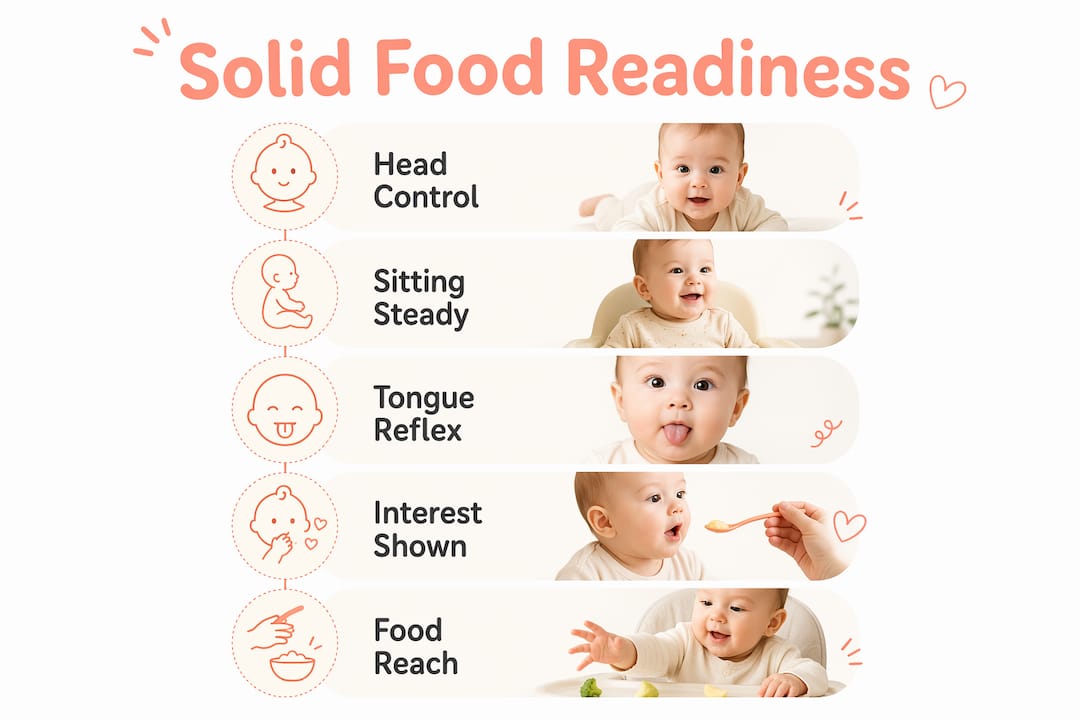
Physical readiness is the first checkpoint. A baby who cannot hold their head steady, sit with minimal support, or coordinate a swallow is not physically equipped to eat solids safely. Introducing food before these milestones are in place does not accelerate development. It increases the chance of refusal and can create negative associations with mealtimes that linger for months.

The tongue-thrust reflex deserves special attention. This reflex is protective by design. It pushes anything that is not liquid out of the mouth. When you see your baby spitting purée back at you, that is likely the reflex at work, not a food preference. It fades naturally, and trying to push past it creates frustration on both sides.
Check the 5 readiness cues before you start. These include showing interest in food, reaching for objects, and losing the tongue-thrust reflex. Premature introduction, before these signs appear, is one of the most common and most preventable causes of feeding resistance.
Pro Tip: If your baby consistently pushes food out with their tongue after 6 months, wait one to two weeks and try again. Readiness can shift quickly at this age.
How sensory sensitivity drives food rejection
Sensory processing plays a larger role in infant feeding than most parents expect. A baby’s nervous system is still calibrating how to interpret taste, texture, temperature, and smell simultaneously. When a new food hits all four senses at once, the response can look like rejection when it is actually just overload.
At 8 months, food refusal often spikes because sensory awareness sharpens. Textures that were tolerated at 6 months can suddenly trigger gagging or a hard turn of the head. This is a normal developmental phase, not a sign that something is wrong, as long as weight and milestones are on track.
The gag reflex is frequently misunderstood. Parents often interpret gagging as choking, which causes visible alarm that the baby picks up on immediately. In reality, gagging is a safety mechanism that moves food away from the airway. It is loud, dramatic, and completely normal. Choking is silent and requires immediate action. Learning to tell the difference, covered in detail in this guide on gagging vs. choking, reduces parental anxiety and keeps mealtimes calmer.
Autonomy is the other major driver at this stage. Around 6–9 months, babies enter what developmental specialists call the “no phase,” where asserting control becomes a primary goal. Feeding refusal is often a behavioral strategy to communicate discomfort or a desire for independence, not defiance. Offering self-feeding opportunities directly addresses this.
Here is a practical sequence for reducing sensory-driven refusal:
- Start with a single new texture at a time. Do not combine a new flavor and a new texture in the same meal.
- Offer pre-loaded spoons so your baby controls the moment of entry.
- Let your baby touch and explore food before eating it. Sensory play with food is not wasted time.
- Progress textures gradually. Smooth should be a ramp, not a residence. Move toward lumpy, then soft chunks, then finger foods over several weeks.
- Keep portions tiny. A teaspoon of a new food is enough for an early exposure.
“Feeding refusal is often a behavioral strategy by babies to communicate discomfort or desire for autonomy, not defiance.” Recognizing this reframes the entire mealtime dynamic.
Pro Tip: Offer new textures when your baby is in a good mood and not tired. Sensory tolerance drops significantly when a baby is fatigued.
Does caregiver behavior affect whether babies accept solids?
Caregiver behavior is one of the most powerful and most overlooked factors in infant feeding. The way you respond during a refusal shapes your baby’s long-term relationship with food. Parental stress is unconsciously transmitted to babies during feeding, and a tense caregiver reliably produces a tense, resistant baby.
Timing matters more than most parents realize. The ideal window for offering solids is 60–90 minutes after a milk feed. Too soon, and your baby is still full from breast milk or formula. Too late, and they are too hungry and irritable to manage the effort of learning a new skill. That 60–90 minute window is when hunger and patience align.
The feeding environment also shapes outcomes. Screens and other distractions during meals reduce a baby’s ability to tune into their own hunger cues. This undermines the long-term goal of self-regulated eating. A quiet table, consistent timing, and a calm caregiver create the conditions where acceptance is most likely.
Key principles for a pressure-free feeding approach:
- Never force, coax, or trick. Phrases like “one more bite” or airplane spoon games teach babies to ignore their own fullness signals.
- Follow the Division of Responsibility. You manage what, when, and where. Your baby decides whether and how much.
- Stay neutral during refusals. A calm “okay, we’re done” removes the reward of a strong reaction.
- Eat together when possible. Babies learn by watching. Seeing caregivers eat the same foods is one of the most effective exposure tools available.
For a broader look at structuring meals across the week, the meal planning guide from Yummy Bites app walks through age-appropriate scheduling in practical detail.
When does food refusal signal a medical problem?
Most feeding refusal is developmental and resolves with patience and consistent exposure. Some refusal, however, signals an underlying medical issue that needs professional attention. Knowing the difference protects your baby and saves you months of unnecessary stress.
Medical conditions including GERD, eosinophilic esophagitis, oral-motor delay, and constipation can all present as feeding refusal. These conditions make eating genuinely painful or physically difficult, so the refusal is not behavioral. It is protective.
| Warning Sign | What It May Indicate |
|---|---|
| Consistent weight loss or poor gain | Inadequate intake; possible medical cause |
| Arching back during or after feeds | GERD or esophageal discomfort |
| Persistent vomiting after solids | Possible food intolerance or reflux |
| Gagging that worsens over time | Oral-motor difficulty or sensory processing issue |
| Extreme distress at every meal | Feeding aversion requiring specialist support |
Normal developmental gagging decreases as your baby gains experience with textures. If gagging is getting worse rather than better, or if your baby is losing weight, that pattern warrants a call to your pediatrician. A feeding therapist, occupational therapist, or speech-language pathologist can assess oral-motor function and sensory processing in ways a standard well-child visit cannot.
Pro Tip: Keep a simple feeding log for one week before any pediatric appointment. Note what was offered, how much was eaten, and any physical reactions. This data helps clinicians identify patterns quickly.
How to help babies eat solids: strategies that actually work
The most evidence-backed principle in infant feeding is repeated exposure. Babies need to encounter a new food 10–15 times before they reliably accept it. The first five exposures are mostly about flavor calibration, not nutrition. Early refusals are data-gathering, not permanent decisions.
Self-feeding and pre-loaded spoons are among the most effective tools for overcoming resistance. When your baby controls the spoon, they control the pace and the moment of contact. That autonomy reduces the power struggle that makes so many mealtimes difficult.
Practical strategies that consistently improve acceptance:
- Rotate textures gradually. Move from smooth purées to mashed, then soft lumps, then soft finger foods. Abrupt texture jumps trigger the gag reflex and set back progress.
- Pair new foods with accepted ones. Mixing a new vegetable into a familiar purée lowers the sensory barrier.
- Use food play outside mealtimes. Letting your baby touch, squeeze, and explore food without any expectation of eating builds comfort with new textures.
- Keep portions small. A teaspoon of a new food is a full serving at this stage. Small portions feel less overwhelming and reduce waste.
- Stay consistent with timing. Offering solids at the same time each day builds a routine your baby can anticipate.
| Approach | Why It Works |
|---|---|
| Repeated exposure (10–15 times) | Builds familiarity; early refusal is not permanent rejection |
| Pre-loaded spoons | Gives baby control; reduces resistance to spoon feeding |
| Gradual texture progression | Prevents sensory overload; supports oral-motor development |
| Eating together as a family | Modeling accelerates acceptance through observation |
| Pressure-free environment | Removes negative associations from mealtimes |
For a library of age-appropriate first foods matched to developmental stages, the foods library from Yummy Bites app is a practical starting point. Safe food introduction, covered in detail for new parents here, walks through how to sequence foods to minimize resistance and build positive associations from the start.
Key takeaways
Babies resist solid food for predictable, manageable reasons, and understanding those reasons is the most direct path to calmer mealtimes.
| Point | Details |
|---|---|
| Developmental readiness comes first | Wait for head control, sitting stability, and loss of tongue-thrust reflex before starting solids. |
| Sensory overload drives most early refusal | Introduce one new texture or flavor at a time to reduce overwhelm. |
| Timing the meal window matters | Offer solids 60–90 minutes after a milk feed for the best chance of acceptance. |
| Pressure backfires every time | Follow the Division of Responsibility: you choose what is offered, your baby chooses whether to eat. |
| Repeated exposure is the core strategy | Most babies need 10–15 exposures before accepting a new food consistently. |
What i’ve learned after years of watching families at the table
The hardest thing to tell a parent who is worried about their baby’s eating is this: your anxiety is probably making it worse. Not because you are doing anything wrong, but because babies are extraordinarily good at reading the adults around them. When you hold your breath every time the spoon goes in, your baby feels that.
What I have seen work, consistently, is parents who treat mealtime as exploration rather than performance. The goal at 6 months is not nutrition. Breast milk or formula still covers that. The goal is exposure, curiosity, and building a positive relationship with food. When parents genuinely internalize that, the pressure drops, and so does the refusal.
The mistake I see most often is interpreting early refusal as a permanent verdict. A baby who spits out sweet potato on Monday is not a baby who hates sweet potato. They are a baby who encountered something unfamiliar. Offer it again next week. And the week after. Most parents give up after two or three tries. The research says 10–15 exposures. That gap explains a lot of “picky eaters.”
One more thing worth saying plainly: if mealtimes feel like a battle every single day, something needs to change. That might be timing, environment, or approach. It might also be a medical issue worth investigating. Trust your instincts. You know your baby. Getting a second opinion from a feeding specialist is not an overreaction. It is good parenting.
Make mealtimes easier with yummy starts app
Starting solids does not have to feel like guesswork. Yummy Bites app supports over a million families through exactly this stage, with 392 recipes built around developmental readiness, allergen tracking, and step-by-step serving instructions created by pediatric specialists.
Whether you are just beginning with single-ingredient purées or moving toward soft finger foods, the baby recipes and meal planner inside Yummy Bites app gives you a clear, age-matched plan for every week. No more staring at the fridge wondering what is safe to offer next. Each recipe comes with texture guidance and portion sizes so you can move through stages with confidence, not anxiety.
FAQ
When do babies typically start accepting solid foods?
Most babies show readiness for solids between 4 and 6 months, but the CDC recommends waiting until around 6 months. Acceptance usually builds gradually over weeks of consistent, low-pressure exposure.
How many times should i offer a new food before giving up?
Research shows babies need 10–15 exposures to a new food before reliably accepting it. Early refusals are part of the learning process, not a final answer.
Is gagging during solid feeding normal?
Yes. Gagging is a protective reflex that moves food away from the airway. It is expected and helpful during early solid feeding. Persistent or worsening gagging, however, warrants a pediatric evaluation.
What is the division of responsibility in feeding?
The Division of Responsibility, developed by Ellyn Satter, means the caregiver controls what food is offered, when, and where. The baby controls whether to eat and how much. This model reduces mealtime pressure and long-term food aversion.
When should i consult a doctor about feeding refusal?
Seek medical advice if your baby is losing weight, arching their back consistently during meals, vomiting after most feeds, or showing extreme distress at every mealtime. These signs may point to conditions like GERD or oral-motor difficulties that need professional assessment.
Recommended

This article is for general educational purposes only and is not a substitute for professional medical advice, diagnosis, or treatment. Always consult your pediatrician or a qualified healthcare provider about your baby's diet, allergies and readiness for solids.